Amazon PPC (pay-per-click) is Amazon’s ad system: sellers bid to appear in search results and on product pages, and pay only when a shopper clicks. PPC has two goals. It makes products visible to shoppers who would not find them, and it builds the organic ranking that keeps selling without ad spend.
Most sellers start Amazon PPC by asking what it will cost. The better first question is what each campaign is for. Without that answer, ad spend grows, ACoS looks acceptable, and the P&L gets worse every month.
I have managed Amazon and Walmart advertising for more than five years across the US, UK, EU and Canada. The brands I manage today add up to $5.1M+ in annual revenue at an average TACoS of about 13.5%. Every one of those accounts runs on one idea: PPC rents the shelf. Organic rank lets you own it.
This guide explains what Amazon PPC is, how it works, and how to use it for its two goals. For campaign structure, bidding and weekly optimization, read my full Amazon PPC management playbook.
Table of Contents
What is Amazon PPC?
Amazon PPC is the advertising model behind Amazon’s sponsored ads. You choose the searches and product pages you want to appear on, set the most you will pay per click, and Amazon charges you only when a shopper clicks.
Amazon defines pay-per-click as a model where “a fee is charged to an advertiser each time an ad is clicked”. A sponsored result looks almost the same as an organic one, apart from a small “Sponsored” label. The shopper is already searching to buy, and your ad sits inside the results they scan.
The model is now a huge part of Amazon. Its advertising revenue passed $68B in 2025, with $21.3B in Q4 alone. On competitive searches, part of the first screen of results is paid, so PPC is part of how products get seen at all.
PPC on Amazon vs Amazon advertising
- PPC on Amazon is the pricing model: you pay per click. It covers Sponsored Products and most Sponsored Brands and Sponsored Display campaigns.
- CPC (cost per click) is the metric: what each click actually cost.
- Amazon Ads is the whole advertising business, including formats bought per 1,000 impressions, such as Amazon DSP and Streaming TV.
You need a Professional selling account to advertise, and Sponsored Brands and display ads require a brand enrolled in Brand Registry. Each ad type gets its own guide in my Amazon ad types article.
How does Amazon PPC work?
Amazon PPC is a real-time auction. Each time a shopper searches or opens a product page, Amazon decides which ads to show, where, and at what price.
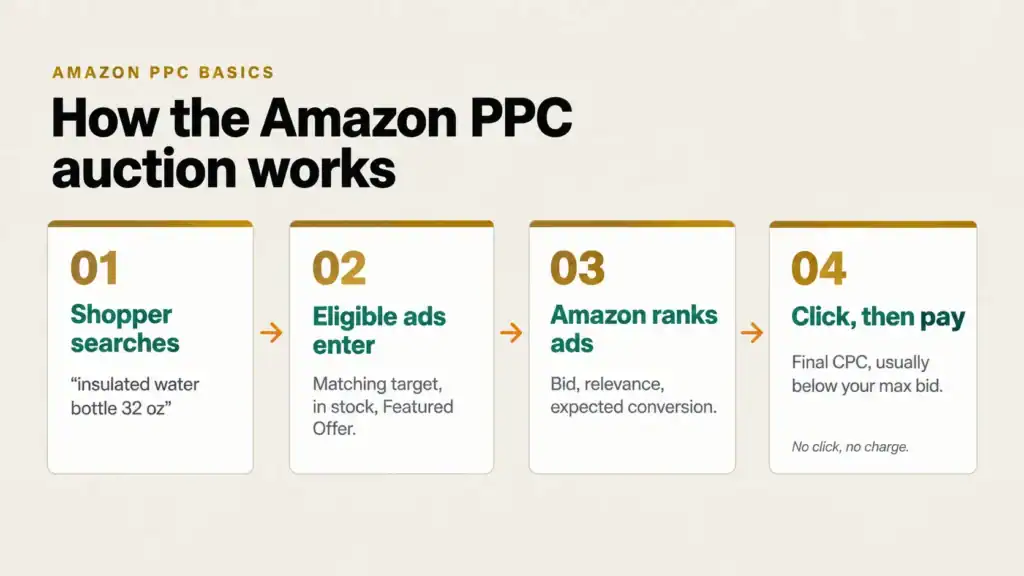
- A shopper searches, for example “insulated water bottle 32 oz”.
- Eligible ads enter. Advertisers whose keywords or product targets match join the auction if the product is in stock and eligible for the Featured Offer (the Buy Box).
- Amazon ranks the ads by bid, relevance and how likely each ad is to be clicked and convert.
- The shopper clicks, and you pay. No click, no charge.
The highest bid does not always win. Amazon says “the auction considers factors beyond bid to determine both ad placement and final CPC”. Your bid is a ceiling, and the final CPC usually lands below it. Budgets cap spend, and Amazon states the final cost will never be more than the amount you have set. How CPC is set and how bidding strategies change it is covered in my CPC guide.
One detail most beginners miss is attribution. Amazon credits a sale to your ad if the shopper buys within a window after clicking: 7 days on Sponsored Products and 14 days on Sponsored Brands and Sponsored Display, for sellers. Treat ad sales as an estimate of influence, not a receipt.
The Two Goals of Amazon PPC
Every campaign should serve one of two goals:
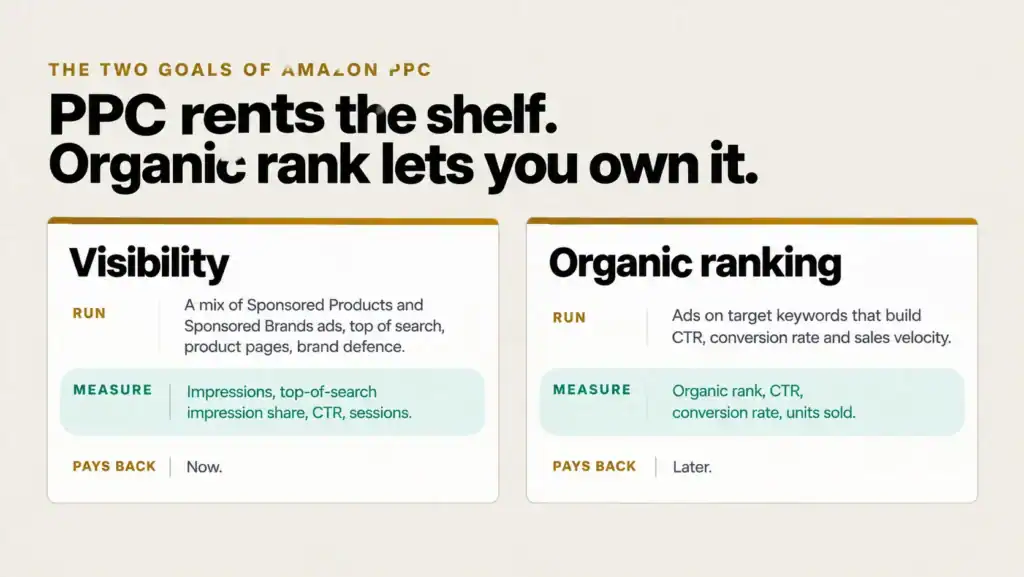
- Visibility: put the product in front of shoppers and bring them to its detail page.
- Organic ranking: build the product’s position in unpaid search results.
Both cost money up front and pay back differently. Visibility pays back now, in sales you would not otherwise make, for as long as you fund it. Organic ranking pays back later, in sales you no longer pay a click for.
Goal 1: Improve product visibility
The first goal of PPC is visibility. Amazon search results are crowded and shoppers rarely scroll far, so a product on page three is close to invisible however good it is. PPC puts it on page one, at the top of search and on competitor product pages, and drives shoppers to its detail page.
Visibility for newly launched products
A new listing has no sales history, so it ranks nowhere organically. PPC is the only fast way to get it seen.
- Run a mix of Sponsored Products and Sponsored Brands ads to drive initial visibility. Sponsored Products places the product in search results and on competitor pages; Sponsored Brands puts your brand and range at the top of search.
- Accept a higher ACoS for a set period, often 6 to 8 weeks, because the goal is impressions, clicks and first sales.
- Judge it on impressions, click-through rate and the first conversions, not on profit yet.
Visibility for products already selling
An established product needs different visibility work:
- Protect positions it already holds, especially on your brand name, where competitors bid to appear above you.
- Expand to new searches found in the search term report.
- Push at key moments such as Prime Day, holiday season or a new variation launch.
The goal is no longer to be found at all. It is to stay found where it matters and win the searches you are not on yet.
Driving shoppers to the detail page
An ad buys the impression. The click is earned by what the shopper sees: main image, title, price, star rating and review count. A visible ad with a weak click-through rate spends budget without bringing traffic.
Before you raise bids for visibility, check what the shopper sees next to your ad:
- Main image: clear on a phone screen, showing the product and its size or use.
- Title: the first 75 characters carry the product, its main benefit and the key search term. Amazon cut titles to 75 characters on 27 July 2026.
- Price and offer: in line with the listings around it, with a coupon or Prime badge if competitors have one.
- Reviews: a star rating and count that hold up against page-one competitors.
Once shoppers land, the detail page has to close the sale. Visibility campaigns fail when the ad promises one thing and the page delivers another.
Awareness, consideration and purchase
Visibility works at three stages of the shopper’s journey, and each stage needs a different strategy:
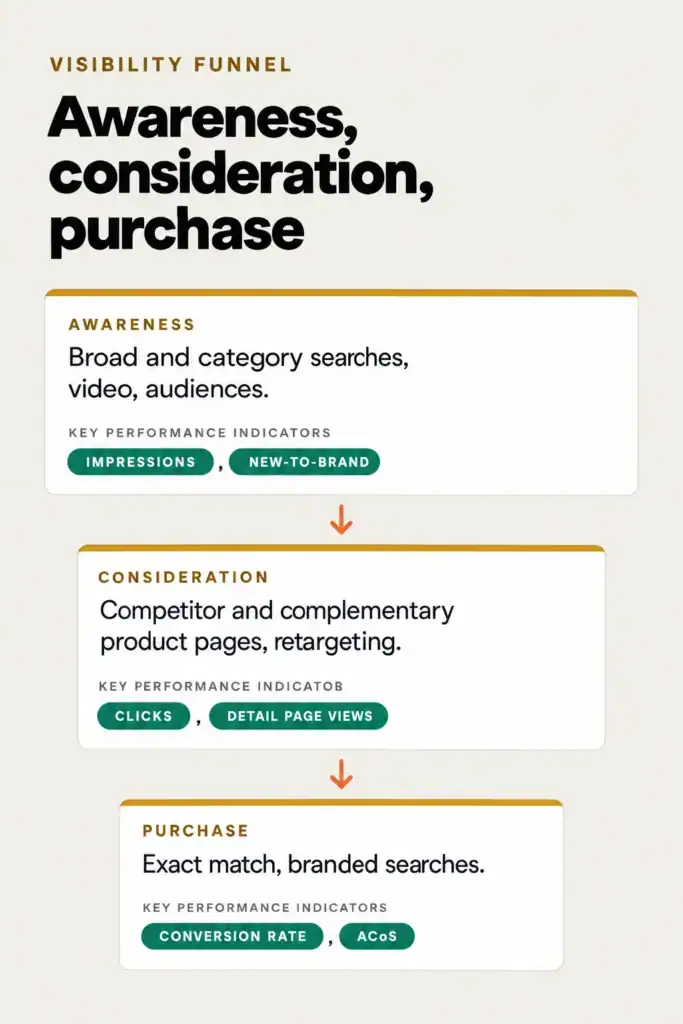
- Awareness: shoppers who do not know your brand. Broad and category searches, Sponsored Brands video, and audience ads. Judge it on impressions and new-to-brand customers.
- Consideration: shoppers comparing options. Ads on competitor and complementary product pages, and retargeting shoppers who viewed your listing. Judge it on clicks and detail page views.
- Purchase: shoppers ready to buy. Exact match on high-intent searches and your own brand terms. Judge it on conversion rate and ACoS.
New products lean on awareness and consideration. Established products spend more at purchase and on protecting branded searches. The keyword kinds behind each stage (defensive, offensive and category) are in my keyword guide.
Visibility in AI shopping
Search is no longer only a list of results. On 13 May 2026, Alexa for Shopping replaced Rufus as Amazon’s AI shopping assistant, and since 25 March 2026 Sponsored Prompts shown inside those conversations are billable. Shoppers now ask questions such as “which water bottle keeps drinks cold for 24 hours?” and get a short answer with products in it. The visibility goal is the same: be in front of the buyer when they decide. I cover both changes in the 2026 updates section of my PPC management guide.
Changes like these land every few weeks. Get them explained with real account numbers in The Margin Memo, my margin-first Amazon newsletter, twice a month. Ask to join here.
How to measure visibility
- Impressions: how often the product was shown.
- Top-of-search impression share: the share of top-row impressions you won for a keyword. It shows whether you own the most valuable position.
- Click-through rate: whether shoppers want what they see.
- Sessions: detail page visits in Business Reports. More visibility should mean more sessions.
Goal 2: Improve organic ranking on the SERP
The second goal is organic ranking: moving the product up the unpaid results on the search results page (SERP). This is where PPC earns back what it costs, because organic clicks are free.
How Amazon PPC ads build organic ranking
Amazon does not publish its ranking formula. Across the accounts I manage, three signals consistently move organic rank for a search term: click-through rate, conversion rate and sales velocity. Amazon PPC ads feed all three. When a shopper searches “insulated water bottle 32 oz”, clicks your ad and buys, that counts as a click and a sale for that search. With steady sales on a keyword over several weeks, the product starts to rise organically for it.
Track organic rank for your target keywords alongside CTR, conversion rate and units sold on them. The full ranking process, from choosing keywords to lowering bids once rank holds, is covered in my upcoming PPC strategies guide.
How organic ranking improves brand profitability
As organic rank grows, more sales arrive without a click cost, and TACoS (ad spend divided by total sales) falls. That is how PPC improves the profitability of the whole brand, not just one campaign.
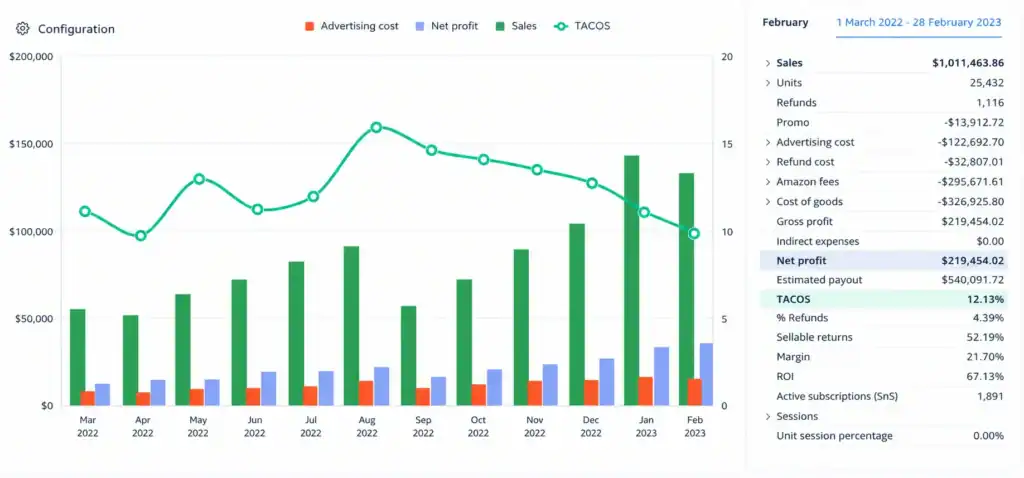
A real example from an intimate care brand on Amazon US, over 12 months (1 March 2022 to 28 February 2023):
| Metric | Result |
|---|---|
| Total sales | $1.01M |
| Net profit | $219.4K |
| Margin | 21.70% |
| TACoS (12 months) | 12.13% |
| ROI | 67.13% |
| Monthly sales, March 2022 → February 2023 | about $54K → $131K |
| Monthly TACoS, August 2022 peak → February 2023 | about 15.8% → 9.6% |
Monthly sales grew about 2.4x over the year. TACoS peaked during the August 2022 push, then fell every month to February 2023 while sales kept climbing, and the brand kept a 21.70% margin across the year.
Why PPC goals need a product worth advertising
Neither goal works on a weak product. PPC can buy visibility, but it cannot buy a click or a sale the product does not earn. Before you spend, the product needs four things:
- High quality. Poor quality shows up in reviews and returns, and a low star rating drags down CTR and conversion on every ad.
- Clear intent. A shopper should know from the image and title what the product is and who it is for. Clear intent keeps the ad matched to the right searches and the right buyers.
- A USP. Something that sets it apart from the ten listings around it: a feature, a size, a bundle, a material. Without one, the only lever left is price.
- Value for money. The shopper has to feel the price is fair for what they get, compared with the options on the same screen. A $34 bottle can beat a $24 one if the page shows why it is worth $10 more, such as a lifetime warranty or a larger capacity.
I learned this with a bags brand on Amazon US. It had been out of stock, lost most of its rank, and restarting ads alone did nothing. Results came only after the product, pricing and inventory were fixed with a margin-first relaunch: monthly sales went from $22K to $71K (+220%) between December 2021 and August 2022, with COGs down 7%. The full story is in the bags brand turnaround case study. What makes a product a PPC winner, from features to a full SWOT, gets its own guide.
Is Amazon PPC worth it?
For a good product with healthy margins, yes. Amazon’s data shows sellers who started Sponsored Products saw 34% more sales growth in the four weeks after starting than sellers who did not.
The cost worry is real. In Jungle Scout’s 2025 seller survey, 32% of sellers named growing advertising costs as a concern. The answer is to give every campaign a goal and cut the spend that serves neither.
PPC is not worth it yet when the product is not ready, the margin is too thin to compete, or stock will not last the next 60 to 90 days.
How to start Amazon PPC with a clear goal
- Check eligibility: Professional selling account, Featured Offer eligibility, and Brand Registry for Sponsored Brands and Sponsored Display.
- Check the product: quality, clear intent, a USP and value for money, then the listing that shows them.
- Work out break-even ACoS: profit per unit before ads divided by price.
- Write each campaign’s goal: visibility or organic ranking, with its keywords and KPI.
- Launch a mix of Sponsored Products and Sponsored Brands campaigns on the keywords that describe the product best, each with its written goal.
- Review weekly: harvest converting search terms, add negatives, and check rank and TACoS.
FAQs
Do I pay if a shopper clicks my ad but doesn’t buy?
Yes. You pay for every valid click, whether or not it becomes an order. That is why conversion rate matters: a listing that converts poorly makes every sale more expensive.
Can individual sellers or KDP authors run Amazon PPC?
Sellers need a Professional selling account; the Individual plan cannot run sponsored ads. KDP authors and book vendors can run Sponsored Products for their books.
Can vendors run Amazon PPC?
Yes. Vendors selling to Amazon through Vendor Central run the same sponsored ads in the Amazon Ads console. One reporting difference: vendors get a 14-day attribution window on Sponsored Products, where sellers get 7 days.
Is Amazon PPC available outside the US?
Yes. Sponsored Products runs in Canada, Mexico, Brazil, most of Europe, parts of the Middle East and Asia Pacific, and South Africa. Each marketplace has its own campaigns, budgets and bids.
How I use PPC for visibility and ranking on six- and seven-figure brands
Every account I take on starts the same way: check the product is ready, set break-even ACoS for every advertised SKU, give every campaign a written goal, and set a TACoS target for the brand. Weekly bids, negatives and harvesting are then measured against those numbers.
That is how the portfolio I manage holds an average TACoS of about 13.5% on $5.1M+ in annual revenue. For the full method, read the Amazon PPC management playbook.
If your ads are spending and you are not sure what each campaign is for, happy to walk through your account on a short call. Calls run until 2 pm EST.