An Amazon PPC agency runs your ads for a fee often tied to ad spend, across a shared client portfolio. An in-house expert sits inside your team, owns the full ads strategy with deals and promos, knows your COGs and inventory, and reports on TACoS and P&L. For 6-7 figure brands with a team, the expert grows the brand faster.
Every Amazon brand reaches the point where the founder can no longer run PPC alone. Ad spend is too large to manage by feel, and the account needs someone in it every day. The usual next step is to hire an Amazon PPC agency. For a brand that already has a team, that is often the slower and more expensive choice.
I have managed Amazon and Walmart advertising for more than five years across the US, UK, EU and Canada. The brands I manage today add up to $5.1M+ in annual revenue at an average TACoS of about 13.5%. I run seven brands, not seventy, and that difference is what this article is about.
Below I compare what an agency does with what an in-house expert does, where agencies fall short, what each costs, and when an agency is still the right call. For the wider picture, including the consultant model, read my Amazon PPC management playbook.
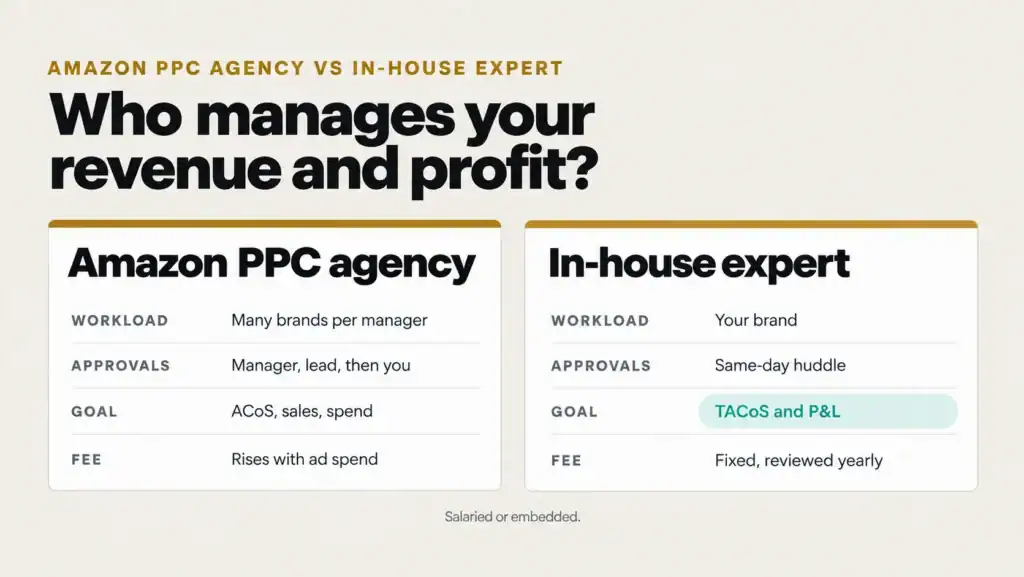
Table of Contents
What an Amazon PPC Agency Does
An Amazon PPC agency is an outside company that runs your Sponsored Products, Sponsored Brands and Sponsored Display campaigns for a monthly fee. Most agency services cover the same core work:
- Campaign structure and launch
- Keyword research, search term harvesting and negative keywords
- Bid and budget management, usually through bid software
- Weekly or monthly reports on ACoS, ROAS, ad sales and spend
- On full-service plans, listing copy, creative, catalog and inventory support
Behind that work there is usually an account manager who talks to you and one or more analysts who make the changes. The account manager handles several brands at once, and changes pass through the agency’s own review before they reach you.
Amazon runs a partner network and awards verified and advanced badges to partners that “have demonstrated expertise” (Amazon Ads). A badge tells you the agency knows the console. It does not tell you how many brands your account manager carries.
Many brands start looking for an Amazon PPC management agency when ads outgrow the founder’s time. An agency fits best when there is no internal team to work with, which the sections below come back to.
What an In-House Amazon PPC Expert Does
An in-house expert is a PPC lead who works inside your team. That can be a salaried employee or an embedded outside expert who joins your Slack or Teams, attends your meetings and works from your internal data. The second is how I work with my brands. Either way, the role covers three things.
1. Part of the team, owning the complete ads strategy plus deals and promos. Ads, Lightning Deals, coupons and Prime-exclusive discounts run as one plan. Ad budgets rise into a deal and come back down after it, instead of the ads and the promos being run by different people.
2. Coordinates pricing changes and creative A/B tests with the team that owns them. The in-house expert works with the pricing or catalog team on price changes and on A/B tests of creatives that improve the product page’s conversion rate (CVR). The expert brings the ad data that shows what needs testing and times the ads around each change.
3. Aware of COGs and inventory, reporting on TACoS and P&L. Every advertised SKU gets a break-even ACoS from its real margin. Ads slow down on SKUs about to stock out. The monthly report shows TACoS, total sales and profit, not only ad sales.
An agency manages your ad account. An in-house expert manages your top-line revenue as well as the bottom-line profits.
Amazon PPC Specialist vs Expert: Is There a Difference?
The job titles overlap, but the work does not. An Amazon PPC specialist executes: builds campaigns, adjusts bids, harvests search terms and pulls reports. An expert owns the outcome: decides what each campaign is for, ties ads to deals, pricing and inventory, and answers for TACoS and the P&L.
Many agencies staff accounts with specialists who follow the agency’s playbook. When you build in-house, hire or embed the expert first. A specialist can then run execution under them.
Agency vs In-House Expert: 6 Differences That Decide Growth
Not every agency works the same way, and good ones exist. These six differences come from how the agency model is built, which is why they show up so often.
| Amazon PPC agency | In-house expert | |
|---|---|---|
| Workload | One account manager across many brands | One brand or a small portfolio |
| Approvals | Internal manager, then client | Directly with the brand owner |
| Communication | Weekly or biweekly calls, email | Slack, Teams, same-day huddles |
| Goal metric | ACoS, sales and spend | TACoS and P&L |
| Data access | Ad console, sometimes sales | COGs, inventory, pricing, promos |
| Software | One rule set across brands | Rules set per brand |
| Low conversion rate | Flags it and leaves the fix to you | Shows what to fix and works with the team on it |
| Fee growth | Rises with ad spend | Rises on performance or yearly review |
One Account Manager, Too Many Brands
Agencies make money by spreading one person across many accounts. An account manager carrying brands of different shapes and sizes, from a new launch to a large catalog, gives each one a slice of the week. The urgent accounts get attention first. The rest run on autopilot between calls, tests get skipped and small problems wait.
Approvals Pass Through Layers
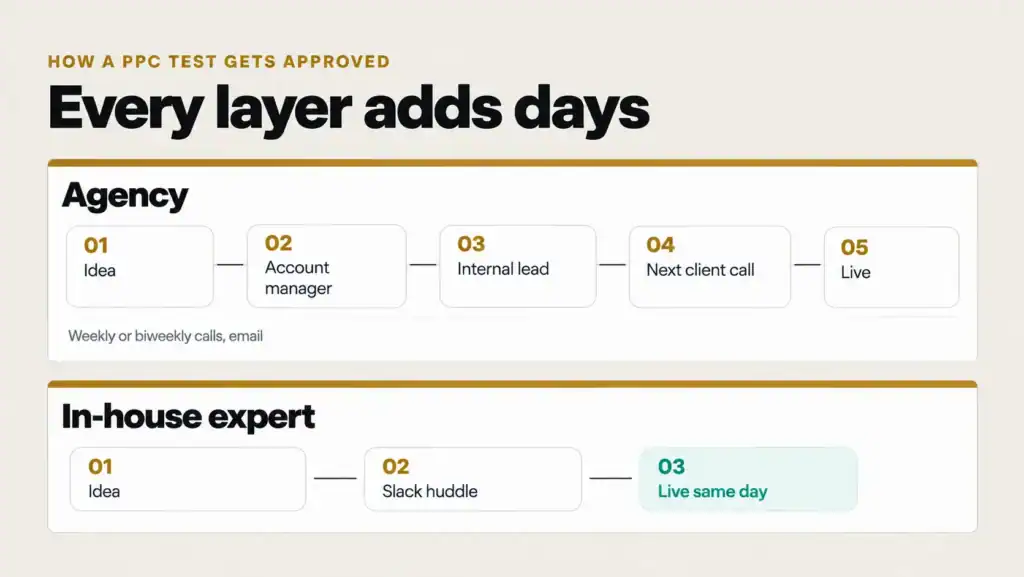
To test anything, such as a new campaign, a placement push or a bid change on a hero SKU, the account manager takes it to an internal lead, then to the client, often on the next scheduled call. Most agencies meet weekly or biweekly and work through email. A shared Slack channel is possible, but replies are slow because the person is working on other brands. Meanwhile a competitor launches a coupon or CPCs rise, and the test runs a week late. An in-house expert sends one message, joins a five-minute huddle and makes the change the same day.
Spend Goals Pay the Agency
Agencies usually report against ACoS, sales and spend targets. The spend target matters most to the agency, because many charge a percentage of ad spend. When the fee rises with spend, recommending more spend serves the agency even when the extra spend does not pay back. ACoS can hold steady while TACoS (ad spend divided by total sales) climbs and profit shrinks, because the ads are buying sales the brand would have made organically.
Ad Types Added to Inflate the Numbers
To keep a client renewing, some agencies add ad types that make the monthly report look bigger. Common examples are retargeting shoppers who were likely to buy anyway, or branded campaigns on searches no competitor is bidding on. Attributed sales and ROAS go up. Total sales and organic rank stay flat. The report grows, the brand does not. The test is simple: when attributed sales rise, check that total sales rose too.
One Software Rule for Every Brand
Bid software follows rules. An agency running many accounts tends to apply one rule set to every brand, even though a launch and a mature brand need different rules. Some tools, not all, go further: they pause legacy campaigns with years of history and rebuild from scratch, so the software learns from data it collected itself. The history in those campaigns does not move with them. New campaigns start cold, bids climb and ranking slips. Sales stall for weeks, and in the worst case the brand goes into a nose dive. Before signing, ask whether existing campaigns stay live.
Low CVR Flagged, No Fix Offered
When a product converts poorly, most agencies report that the CVR is low and tell the brand owner to improve the listing. They rarely say how. An in-house expert goes further: the search term and Search Query Performance data show which keywords get clicks but no orders, and comparing those results with competing listings points to the cause, such as a price gap, a weaker main image, fewer reviews or a missing attribute in the title. The expert turns that into a brief for the pricing or catalog team, then sets the ads around the test.
See TACoS-first management in practice. In the bags brand turnaround case study, monthly sales went from $22K → $71K (+220%) on Amazon US between Dec 2021 and Aug 2022. If your agency’s reports keep growing while your P&L does not, happy to walk through your account on a short call.
Amazon PPC Agency Pricing vs the Cost of an In-House Expert
Amazon PPC agency pricing follows four models: a flat monthly retainer, a percentage of ad spend, a percentage of sales, or a hybrid of a retainer plus a percentage. Two structures are the most common.
- Percentage of ad spend. Typically 10-20% of the monthly ad budget (Sellermate). Other agencies quote 10-30% (Kyzenn), or 8-15% of planned spend for new accounts (AMZDUDES).
- Retainer plus 1-2% of ad spend. The retainer covers management, and the percentage grows the fee as spend grows.
Both structures scale with spend, not with work. Doubling ad spend doubles a percentage-of-spend fee, even though the account does not take twice the effort. Full-service plans that add listings, creative and catalog work sit at the top of these ranges.
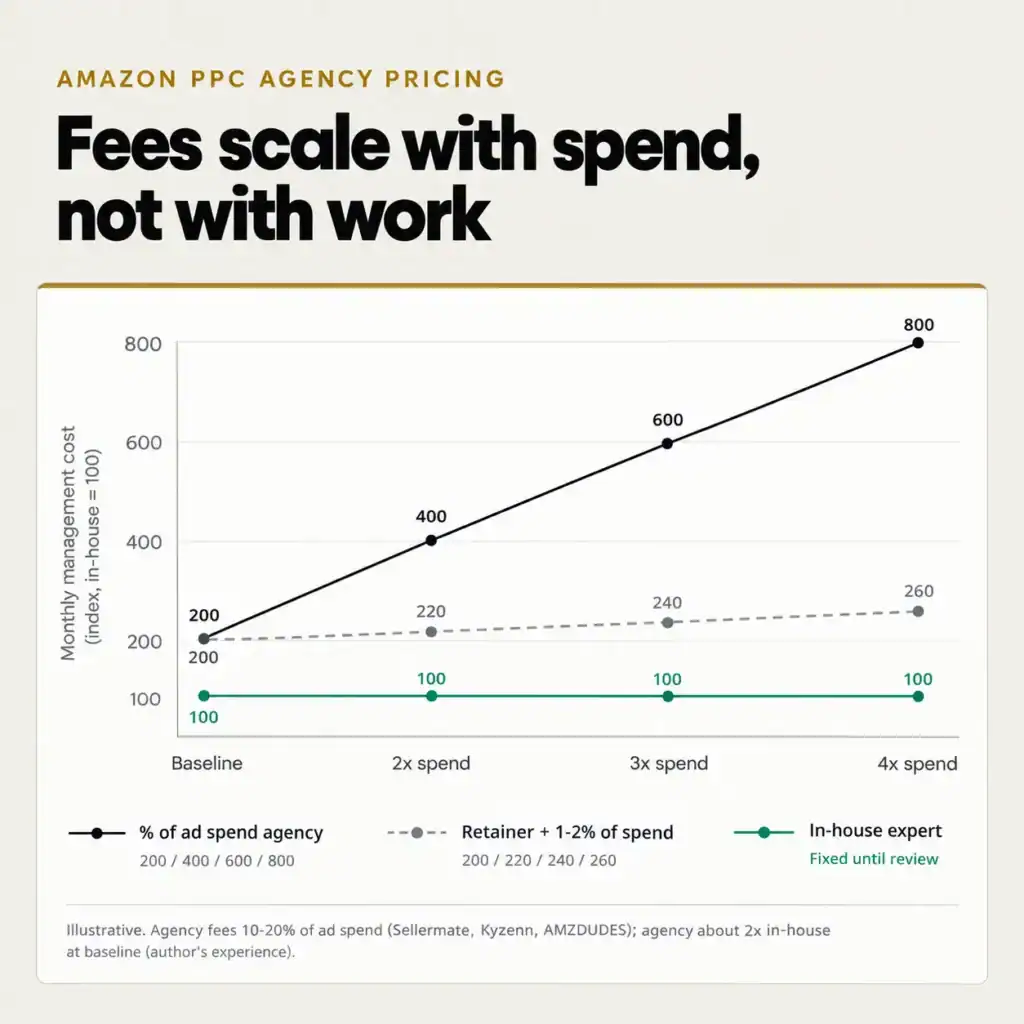
An in-house expert costs a fixed amount each month, whether salaried or embedded. That pay rises on performance or at a yearly review, not because the brand spends more on ads.
| Monthly ad spend | Percentage-of-spend agency fee | Retainer + 1-2% agency fee | In-house expert |
|---|---|---|---|
| Baseline | 10-20% of spend | Retainer + 1-2% of spend | Fixed monthly pay |
| 2x baseline | Fee doubles | Retainer + 1-2% of the larger spend | Unchanged until review |
| 4x baseline | Fee is 4x | Retainer + 1-2% of the larger spend | Unchanged until review |
| Cost as a share of ad spend | Stays at 10-20% | Falls slowly | Falls as spend grows |
Across the accounts I have worked on, the agency route costs about 2x an in-house expert per month for the same account. On percentage-of-spend pricing the multiple is higher, and it keeps widening as the brand scales. For mid-market brands with growing ad budgets, that gap is often the deciding number.
When an Agency Is the Right Call
An agency is the better choice in some situations, and the in-house case only works when the brand can support it.
- No internal team. An embedded expert needs someone to work with, and a founder who shares COGs, inventory plans and promo dates.
- You want one contract for everything. Ads, listings, creative, catalog and inventory under one vendor.
- Ad spend is still small. At low spend, a percentage fee can cost less than a fixed hire.
- A short project. An audit, a campaign rebuild or a new marketplace launch.
Outsourced Amazon Ops for Emerging Brands
Emerging brands, usually in their first year or two with a handful of SKUs, often outsource all Amazon operations. That works when you outsource the right parts first. Catalog setup, listing creation, FBA shipments and creative production have clear outputs and are easy to check.
Keep pricing, the promo calendar, COGs and margin data, and the ads strategy close to the founder from day one. Those decisions shape profit. The point to bring PPC in-house comes when ads become one of the largest lines in your P&L, or when a percentage-of-spend fee starts to cost more than an expert would. Operations can stay outsourced after that if it still works.
Amazon PPC Outsourcing Guidelines
If you outsource, set the terms before the agency’s first login. Amazon itself suggests requesting proposals from 5-6 potential partners and comparing them on goals, budget and timeline (Amazon Ads). Then put these six points in writing.
- Keep ownership. Give the agency its own user login with only the permissions it needs. Amazon Ads lets you invite users “with standardized roles (admin, editor, viewer)” or custom permissions (Amazon Ads).. You own the Seller Central and Amazon Ads accounts; the agency is a user on them.
- Protect campaign history. No existing campaign is paused or archived without your written approval.
- Report on TACoS and profit. Each month, ask for total sales, TACoS and the split between ad and organic sales, not only ACoS and attributed sales.
- Name the people and the response time. Who works on your account, how many brands they carry, and a reply within one business day.
- Avoid long lock-ins. Month-to-month or a short first term with a 30-day notice period.
- Plan the exit. On termination you keep every campaign, negative keyword list, report and creative file, and access is removed the same day.
How to Evaluate an Agency’s Amazon Ads and Catalog Management
Many agencies sell ads and catalog management together. Judge them together, because ads cannot convert on broken listings. Ask:
- How often do you check for suppressed or inactive listings?
- How do you fix variation (parent-child) and browse node errors?
- Who updates titles, bullets, images and A+ content, and do you review ad results after each change?
- Do you pause ads on SKUs that are out of stock or suppressed?
Red flags: one generic report for ads and catalog, no clear answer on who carries your account, a plan to rebuild every campaign on day one, and a fee tied to spend with no TACoS target.
FAQs
Can I start with an agency and move PPC in-house later?
Yes, and many brands do. Run a one-month overlap where the in-house expert shadows the agency, reviews every campaign and takes over the weekly changes before the contract ends. The handover goes smoothly when you have owned the accounts and campaign history from the start.
How do I know my agency is actually working on my account?
Open the Amazon Ads console and check each campaign’s change history. It lists every bid, budget, keyword and status change with its date. Weeks with no changes on an active account are a warning sign, whatever the monthly report says.
Is Amazon PPC software a replacement for an agency or an expert?
No. Software applies rules faster than a person can, but someone still has to set the targets, decide what each campaign is for and connect ads to pricing and inventory. Software works best under an expert who sets customized rules for each brand.
Is a freelancer the same as an in-house PPC expert?
Not always. A freelancer who works from outside on many clients runs much like a small agency. A freelancer becomes an in-house expert when they join your team’s channels, work from your COGs and inventory data, and answer for TACoS.
How I Work as an Embedded Amazon PPC Expert
I work as an embedded expert for seven brands: in each team’s Slack or Teams, with access to COGs and inventory, and accountable for TACoS and P&L. Every account starts with a break-even ACoS for each SKU, a TACoS target for the brand and a written goal for every campaign. Existing campaigns stay live while I restructure around them.
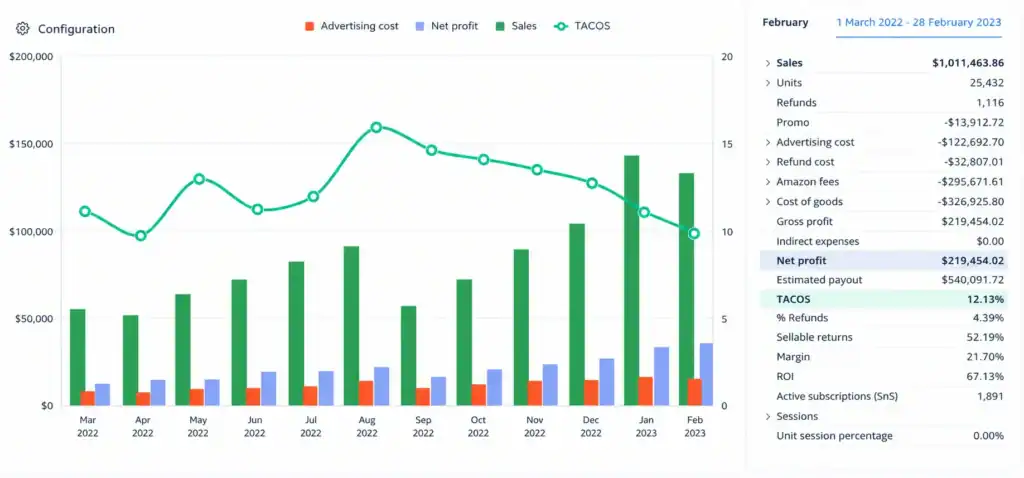
For one intimate care brand on Amazon US, from 1 Mar 2022 to 28 Feb 2023, that approach produced $1.01M in sales at 12.13% TACoS and a 21.70% net margin. Monthly sales grew from about $54K to about $131K, while monthly TACoS fell from a 15.8% peak in Aug 2022 to 9.6% in Feb 2023. The full method is in the Amazon PPC management playbook. New to PPC? Start with what Amazon PPC is and the two goals it serves.
If you are deciding between an Amazon PPC agency and an in-house expert, happy to walk through your account on a short call. Calls run until 2 pm EST.